ProdThink
Product & Tech Publication

Product Thinking, Architecture & System Feasibility

Original in-depth guides covering data serialization contracts, distributed timestamps, cryptographic formats, and system feasibility for Product Managers and engineering leaders.

From OpenClaw to Super Agent: Why Agent Products Looped Back Around
Agents in Practice
Nov 3, 2026•16 min read

From OpenClaw to Super Agent: Why Agent Products Looped Back Around

Products released early this year, shaped by OpenClaw, were mostly bots that newcomers could reach from a chat tool. By April and May, desktop and IDE-style apps such as WorkBuddy spread, letting agents operate inside the actual work environment — the shift from "easy to start" to "actually usable." The second demand is availability: the more useful an agent becomes, the more you want it instantly reachable, which pulled the pendulum back toward bots, now backed by real environment access. The article then adds two further steps — collaboration, moving from personal use to shared use; and letting a well-tuned agent help build and onboard a new one. It closes on DeepSeek's Super Agent as the new variable in the trend, arguing that different products are converging on the same underlying problem: coordination overhead that still lands on the human.


Aine
Read Guide
Hands-On with DeepSeek Creation Mode: Natural Language Kills the Plugin Barrier
AI Products & Industry
Nov 3, 2026•8 min read

Hands-On with DeepSeek Creation Mode: Natural Language Kills the Plugin Barrier

On the evening of November 2, the DeepSeek Harness team posted "your Harness, you define it" and shipped Creation Mode, accompanied by a 1 minute 39 second introduction video. The mechanism is simple to state and significant in consequence: the user describes what they want, the agent writes the code, packages it, and installs it as a plugin usable in DSH. Seven demos shipped alongside — a 3D Transformer visualizer, a video editing console with a multi-track timeline, a paper reader that preserves the original layout, a poster design workbench, a 3D landmark gallery, a theme plugin that turns the entire interface pixel-art, and a usage dashboard tracking tokens and cost. The article walks through an actual test from prompt to installed plugin, notes where friction remains, and concludes that authoring extensions for an agent platform has effectively been reduced to describing an idea.

字母榜
Read Guide
What Is Left for Human-Made Short Dramas Against AI-Generated Ones?
AI Products & Industry
Nov 3, 2026•10 min read

What Is Left for Human-Made Short Dramas Against AI-Generated Ones?

Hongguo's surge has entered a new phase: daily active users exceeding four long-video platforms combined, audiences watching until dawn, the "watch-to-earn" feature taken offline, rumors of annualized revenue approaching 40 billion yuan, and a number-one ranking even in the Taiwan region of China. The biggest driver behind it is the flood of AI-generated short dramas. The piece asks what remains for human-made productions and offers two answers. First, accumulation and staying power: studios with libraries, talent relationships and production craft amortize costs in ways one-off AI generation cannot. Second, holding the high end — even as AI's own premiumization accelerates, human productions should defend quality rather than compete on volume. The subtext is blunt: AI has already won the volume game, so the remaining moat is craft, IP depth, and making work that people seek out instead of scroll past.

壹娱观察
Read Guide
Character.AI Files for Bankruptcy: Was AI Companionship a Fake Trend?
AI Products & Industry
Nov 3, 2026•16 min read

Character.AI Files for Bankruptcy: Was AI Companionship a Fake Trend?

Character.AI reached a $1B valuation within a year and attracted tens of millions of monthly active users by letting people chat with virtual characters — then, on October 12, its parent company filed for bankruptcy protection. The causes named are sustained compute spending, operating costs, and lawsuits and regulatory pressure around minor protection. Disney has emerged as the first bidder at $20 million for a non-exclusive perpetual license to part of its IP. The article uses the case to ask whether AI companionship was ever a real market. Evidence is mixed: on the demand side, usage and revenue are still growing and some players are expanding; on the supply side, inference cost and compliance exposure make profitability elusive. The suggested next openings are less crowded ones — niche scenarios, differentiated product forms, and hardware — rather than another general-purpose companion chatbot chasing the same engagement metrics.

AIX财经
Read Guide
Skill Routing in Practice: Self-Evolving Descriptions from Real Requests
Agents in Practice
Nov 3, 2026•14 min read

Skill Routing in Practice: Self-Evolving Descriptions from Real Requests

The naive fix for a routing error is to hand the failed request to a model, let it rewrite the description, and re-run the whole batch. That produces a new version but answers nothing: why this change, does it target the real conflict, what should the next round do. This practice splits the problem in two — local first-route replay to shorten the feedback cycle, and an iteration loop organized as attribution and optimization direction, concrete description rewrite, regression validation, then recorded lessons reused next round. The running example is two adjacent capabilities that both query data but differ in delivery: one returns the result inside the conversation, the other pushes a notification to an external channel. Writing out the delivery purpose behind the shared steps explains the fix better than adding more query keywords. The selected candidate routed 31 of 34 development requests correctly — 91.18% — a dev-set best pick, not a claim about unseen requests or full online task success. Description growth and feedback cost are tracked as explicit constraints.

Aine
Read Guide
DeepSeek's Super-Agent Architecture Is Already a Product at LobeHub
AI Products & Industry
Nov 3, 2026•10 min read

DeepSeek's Super-Agent Architecture Is Already a Product at LobeHub

On October 31, the DeepSeek Harness team published a Super-agent architecture built on a two-layer Router/Worker split: a resident Router handles communication with the person while Workers execute tasks, so the human steps in for decisions and delivery confirmation rather than shuttling context between sessions. The problem it targets is coordination overhead — as tool use grows, people still switch between conversations to restate background, chase progress and hand off results, and the coordination itself starts to consume the day. The same day, a LobeHub team member reposted the article noting that most of the design is already implemented in their public GitHub repository, which they say is the same code running their live product. The piece traces that arc from LobeChat to LobeHub, illustrates it by building a game, and argues that collaboration mechanics have become an actual product capability rather than a research idea waiting to be validated.

有新Newin
Read Guide
Tencent Launches MusicBuddy: WorkBuddy Gets a Sibling
AI Products & Industry
Oct 31, 2026•17 min read

Tencent Launches MusicBuddy: WorkBuddy Gets a Sibling

MusicBuddy bundles six stages into one pipeline: ideation, creation, editing, distribution, promotion and operation. Its ideation hub draws on listener and fan data across QQ Music, KuGou, Kuwo and Quanmin Karaoke; creation offers multiple models driven by natural-language prompts; a DAW-style multi-track editor sits next to an AI chat box, so you can ask for a stronger drum line in the chorus instead of learning plugins; and distribution covers Tencent's domestic platforms plus Spotify, Apple Music and KKBOX, with AI-generated short-video MV clips and album art. The stated vision is a "one-person label" (OPC). The catch: Deezer reported that in June 2026 AI tracks were over 50% of daily uploads — roughly 90,000 a day — yet only 1-3% of plays. AI has collapsed the cost of making music, not the scarcity of attention. The real test is whether musicians can actually find listeners and get paid.

老曹
Read Guide
How Product Managers Find a Workable AI Entry Point Inside the Business
Product & Methodology
Oct 31, 2026•3 min read

How Product Managers Find a Workable AI Entry Point Inside the Business

The syllabus attacks the gap in three parts. First, locating the right AI entry point in a real business — the typical blockers being missing data, scenarios too narrow to justify, or implementation costs too high, while business teams keep demanding "AI efficiency" without specifying what. Second, hands-on practice: building and running Skills against an e-commerce scenario, so the work is concrete rather than theoretical. Third, which PM capabilities actually transfer and gain value in the AI era. The material targets PMs who need to move from generic enthusiasm to a specific, defensible first deployment. Note that this page is a course promotion post rather than a full article: the body is short, structured around what the course covers, who teaches it, what services come with it, who should attend, and how to register.

起点课堂
Read Guide
Selecting and Running an Agent Data Flywheel Platform: The Zeus Practice at 1688
Agents in Practice
Oct 30, 2026•23 min read

Selecting and Running an Agent Data Flywheel Platform: The Zeus Practice at 1688

Zeus connects business knowledge, data and multi-role agents so AI can analyze against business goals, coordinate execution and follow up continuously. Before adoption, the team's complaint was "examining an elephant by touch": a successful API call says nothing about whether the task actually completed, where the deviation occurred, or whether a fix will hold. AgentLoop adds three layers — observability (see how one request actually executes), evaluation (score against task completion, not call success), and regression validation (failed samples become inputs to the next test run, organized as test sets, regression sets and baseline sets). Implementation uses ARMS GenAI Java Agent probes, datasets of inputs plus outputs plus process traces, and selectable evaluators scored by dimension. Two cases are replayed in detail: a document read that never refreshed, and a subtask result that never came back. The recommendation is to start from the smallest closed loop and grow outward.

周睫毛的伦
Read Guide
Inside Google AI Infrastructure: Chip Mix, Global Deployment, and How Agents Rewrite Datacenter Design
AI Infrastructure
Oct 30, 2026•47 min read

Inside Google AI Infrastructure: Chip Mix, Global Deployment, and How Agents Rewrite Datacenter Design

The central claims: specialization is unavoidable, because general-purpose clouds lose to purpose-built systems; FLOPS are a vanity metric while effective throughput is the accountability standard; and what doubles every six months is token-generation capacity, not raw FLOPS. That mismatch is the hard part — hardware is procured and powered on multi-year cycles while models iterate every few months. The load is not isolated to accelerators: CPU, storage and network demand rise together, and optical circuit switching lets a failed rack be swapped out in milliseconds. Power is treated as a long-term constraint rather than an engineering detail. Performance left on the table has to be deliberately locked into the stack, layer by layer. Running through the whole conversation is one question: how do you build multi-year infrastructure to serve a demand curve that is still changing every quarter?

Z
Read Guide
AI Infra Deep Dive: Linear Attention from DeltaNet and GDN to KDA
AI Infrastructure
Oct 30, 2026•54k words · ~135 min

AI Infra Deep Dive: Linear Attention from DeltaNet and GDN to KDA

The article traces the family tree step by step: removing the denominator and introducing convolution, DeltaNet's write gates and residual writes, GDN's added forget gates, and finally KDA's per-channel forget gates — framing each step as a hypothesis about memory rather than a bag of tricks. It then re-derives everything from the training side: the limits of the RNN paradigm, sequential and causal parallelism, how transformers parallelize attention, why chunk-wise linear attention is the practical middle ground, and the Rope-versus-NoPE decision. Implementation follows: KDA's concrete implementation, how Prefix Cache interacts with recurrent state, and how speculative decoding restores state after verification. Nineteen code blocks and twenty-two tables carry the derivations. The motivation is stated up front: no one can fully explain why reasoning emerges in large models, so this remains an experimental science — hence the insistence on deriving each step instead of accepting "it just works".

浪子爱回头
Read Guide
From AI-Friendly Architecture to Reusable AI Migration Capability at Taobao Live
AI Infrastructure
Oct 30, 2026•29 min read

From AI-Friendly Architecture to Reusable AI Migration Capability at Taobao Live

Taobao Live's recommendation application serves several core traffic scenarios. To get algorithm strategies into experiments quickly, the algorithm team originally wrote and maintained the Java UDFs, graph configurations and code branches for each scenario themselves. That shortened individual experiments, but as maintenance passed to a much smaller engineering team, multiple frameworks, branches and diagnostic paths became the dominant cost: the same public capability existed in several versions, each evolving separately and behaving differently, so a single change had to be understood, evaluated, released and verified branch by branch. The reconstruction therefore targeted the production method, not the source. Three design pillars carry it: unified artifacts with declarative differences (stable capability in code, scenario variation in orchestration), constrained flow semantics with a unified lifecycle, and structured evidence left behind by every execution — illustrated by the Chain ExecuteRemark sample. The aim is an AI-friendly architecture plus a repeatable migration capability, so agents work against explicitly observable behavior instead of inferring it from branches.

长沙王嘉尔
Read Guide
Netlify-Deploy: One SKILL.md That Takes Over Your Netlify Deployments
Agents in Practice
Oct 29, 2026•12 min read

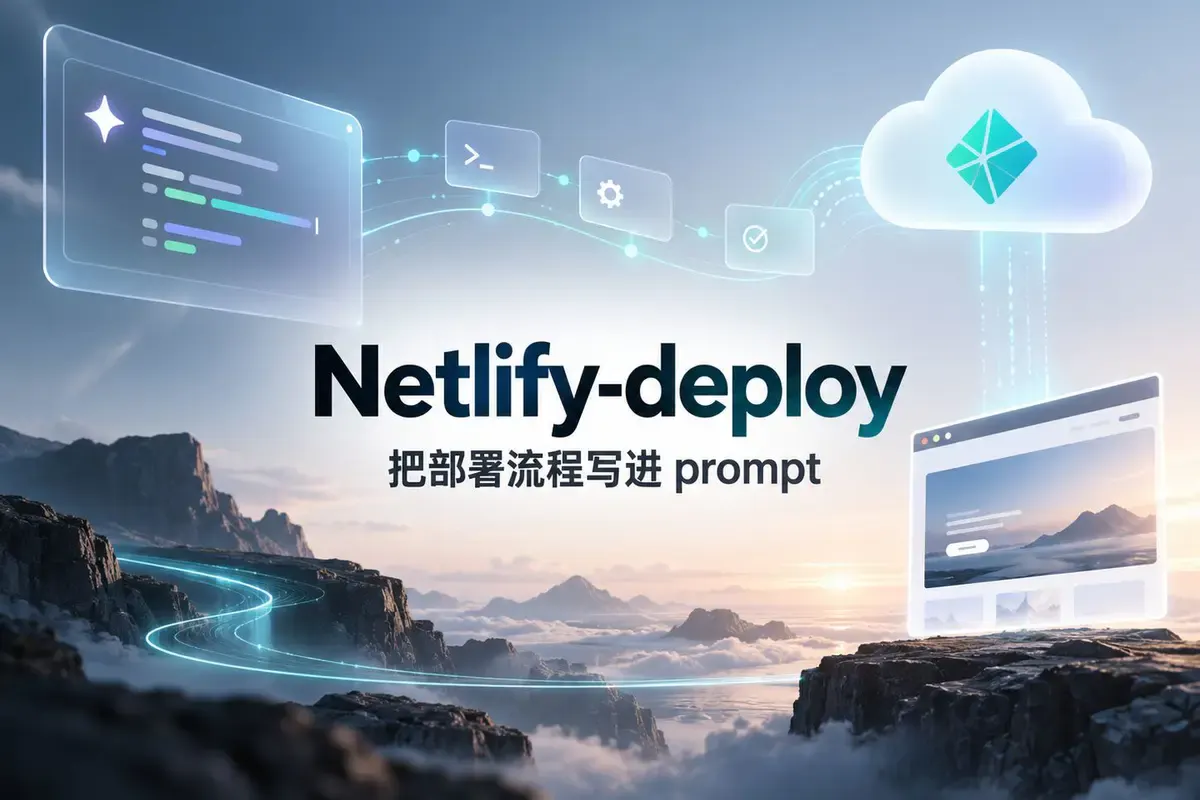
Netlify-Deploy: One SKILL.md That Takes Over Your Netlify Deployments

If your coding assistant does not know Netlify CLI's quirks, it will repeatedly trip over authentication and link. netlify-deploy solves that by writing the whole deployment order into a SKILL.md, so assistants such as Cursor, Codex and Claude Code can follow it step by step instead of improvising commands each time and skipping prerequisites like link. The article runs it for real, examines the command layer (comprehensive but not complete), describes what it looks like in a terminal, and gives a candid read on which parts are genuine engineering and which are just prompt scaffolding. The verdict: excellent as a personal deployment flow memo, especially for multi-project, occasional-deploy rhythms; do not expect it to replace GitHub Actions for production-grade CI/CD. Two expiry dates are flagged — OpenAI has marked the skills repo deprecated, and Smithery's integration layer shuts down at the end of the month — so long-term users should plan a migration.

AI情报员
Read Guide
I Built a Ming-Dynasty PPT Agent Team So I Would Never Write Slides Again
Agents in Practice
May 17, 2026•7 min read

I Built a Ming-Dynasty PPT Agent Team So I Would Never Write Slides Again

The starting observation is that a model's context behaves like human attention — once it gets long, tasks degrade mid-run or stall entirely. While reading Ming-dynasty history, the author noticed the imperial bureaucracy maps surprisingly well onto a multi-agent architecture, so they built the "Ming PPT Agent Team" for producing high-quality decks. Roles are split the way the cabinet and six ministries were: each agent owns a bounded slice — research, outlining, writing, design — so no single context window has to hold the entire job. The article walks through the team structure, how work is handed between agents, and what the resulting decks look like, then assesses honestly where the multi-agent setup genuinely helps and where coordination overhead eats the gains. It is framed as an experiment in making long creative tasks governable rather than a production framework ready for general use.

沃垠AI
Read Guide