प्रकाशित
Foundations of Autonomous Mobile Robotics: A Technical and Functional Overview
Autonomous mobile robots, commonly referred to as AMRs, represent a sophisticated fusion of high-performance hardware and intelligent software. These machines are engineered to execute complex tasks and navigate through their surroundings without the requirement for constant human oversight. As robotics technology advances, AMRs have transitioned from industrial novelties into essential tools that drive efficiency, safety, and innovation across global sectors.
Stanley Rothwell
लेखक

##
Autonomous mobile robots, commonly referred to as AMRs, represent a sophisticated fusion of high-performance hardware and intelligent software. These machines are engineered to execute complex tasks and navigate through their surroundings without the requirement for constant human oversight. As robotics technology advances, AMRs have transitioned from industrial novelties into essential tools that drive efficiency, safety, and innovation across global sectors.
Unlike traditional industrial robotics, which are typically confined to stationary positions or strictly controlled environments, AMRs are designed for mobility in dynamic and unstructured settings. Their defining characteristic is an inherent flexibility that allows them to perceive, react to, and bypass obstacles in real-time. This independence is made possible through a synergy of several core technological pillars.
Core Technologies Powering Autonomous Mobility
The intelligence of an AMR is derived from a sophisticated internal ecosystem that processes environmental data into actionable movement. This process begins with a comprehensive sensor suite. Modern units are outfitted with an array of inputs, including LIDAR for light-based distance measuring, high-resolution cameras for visual recognition, and ultrasonic sensors for proximity detection. Together, these tools allow the robot to identify terrain textures, locate objects, and maintain a 360-degree awareness of its theater of operation.
Navigation and control constitute the second critical pillar. Advanced navigation systems ingest sensor data to construct real-time maps of the environment, a process often supported by Simultaneous Localization and Mapping (SLAM) technology. Control algorithms then analyze these maps to determine the most efficient path to a destination while ensuring the safety of nearby humans and infrastructure. Furthermore, the integration of Machine Learning and Artificial Intelligence allows these robots to refine their performance over time. By learning from previous encounters and environmental variations, AMRs become increasingly capable of managing complex, non-repetitive tasks.
The physical architecture of an AMR is as diverse as its software. While many models utilize a wheeled chassis for indoor efficiency, others employ tracks for rugged outdoor terrain or even articulated legs for navigating stairs and uneven surfaces. Depending on the industry, these robots can be configured with flat surfaces for transporting pallets, integrated shelving for item dispensing, or specialized towing connectors for hauling heavy racks.
##
Diverse Industrial Applications of AMRs
The versatility of autonomous mobile robotics has led to widespread adoption across a variety of professional fields, each utilizing the technology to solve unique operational challenges.
In the healthcare sector, AMRs are utilized to maintain sterile environments through automated disinfection and to manage the logistical flow of medical supplies and pharmaceuticals. This automation allows medical professionals to focus their energy on direct patient care rather than routine transport tasks. Similarly, in the manufacturing and logistics sectors, AMRs have become indispensable. They integrate into existing facility infrastructures to automate inventory management, picking, and internal deliveries, significantly reducing the need for manual labor and optimizing the speed of fulfillment centers.
The retail and hospitality industries utilize AMRs to modernize the guest experience. From providing room service and luggage assistance to guiding customers through large shopping complexes, these robots simplify service delivery and enhance operational consistency. Agriculture is also seeing a transformation through autonomous technology. Specialized robots can now navigate fields to assist in planting, crop monitoring, and harvesting. By collecting precise environmental data and performing targeted actions, AMRs help improve crop yields while lowering the overhead of manual labor.
Strategic Advantages of Implementing Autonomous Systems
The shift toward autonomous mobility is driven by three primary advantages: safety, flexibility, and productivity. AMRs are uniquely suited for "dull, dirty, or dangerous" tasks that might jeopardize human safety. They can operate in extreme temperatures, handle hazardous materials, and manage heavy loads in industrial settings where human presence is not ideal.
From a logistical standpoint, the flexibility provided by AMRs is unmatched by traditional conveyor systems. Because they do not require fixed tracks or wires, they can be redeployed to new tasks or different facility layouts with minimal downtime. This adaptability ensures that a business can scale its automation alongside its growth.
Finally, the implementation of AMRs leads to a significant increase in overall productivity. By delegating the repetitive movement of goods to energy-efficient robotic units, organizations can reallocate their human workforce toward high-value, cognitive activities. These robots are designed for high uptime, requiring only brief windows for recharging, which ensures that production lines and supply chains remain active around the clock.
आपके लिए और खबरें
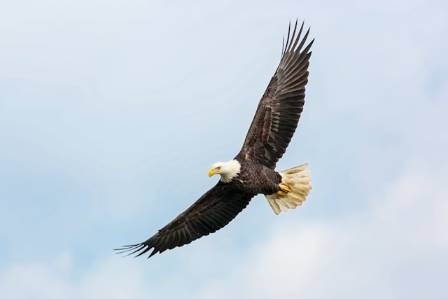
Ten Essential Facts About the Bald Eagle
As a Guinness World Record holder and a symbol of national pride, the Bald Eagle is arguably the most famous bird in North America. These formidable predators are commonly found near large bodies of water, where they construct massive nests and dominate their ecosystems. While their image is synonymous with American identity, these raptors possess several unique and surprising characteristics that go beyond their patriotic reputation.

Unraveling the Charm: The Endearing Allure of Dogs and Cats
If your heart skips a beat at the sight of an exuberant puppy wagging its tail or a drowsy kitten stretching in a yawn, you're not alone. Humans have shared an enduring fascination with the irresistible cuteness of their furry companions for centuries. But what lies beneath this universal adoration? Why do we perceive cats as cute, and what is it about dogs that tugs at our heartstrings? Let's delve into the enchanting world of pet cuteness to unravel the mysteries behind our affection for these charming creatures.

Discover the Diversity: 6 Varieties of Daisies to Illuminate Your Garden
Daisies, an integral part of the vast Asteraceae family, comprise an astounding 10 percent of the world's flowering plants. While the Common Daisy and Gerbera Daisy often steal the spotlight, it's fascinating to note that there are over 20,000 distinct "daisy" species within this extensive plant family. The Asteraceae family boasts not only daisies but also includes members like sunflowers, chrysanthemums, and even lettuce.

Intriguing Seahorse Insights for Children
Despite their unusual appearance, these creatures are classified as fish.

Simple Windmill Drawing: A Beginner's Guide to Illustrating Classic Structures
For hundreds of years, the distinctive silhouette of the windmill has captivated the imagination of artists. These iconic buildings are still a common sight in countries like Denmark, where they serve as a testament to both historical charm and engineering ingenuity. This lesson focuses on simplifying the complex appearance of a windmill into manageable shapes, allowing students to recreate the massive fan structure using basic geometric lines.

The 5 Best Lightweight Vacuums - Summer 2024
Thanks to advancements in design and materials, vacuum cleaners have become increasingly lightweight.